
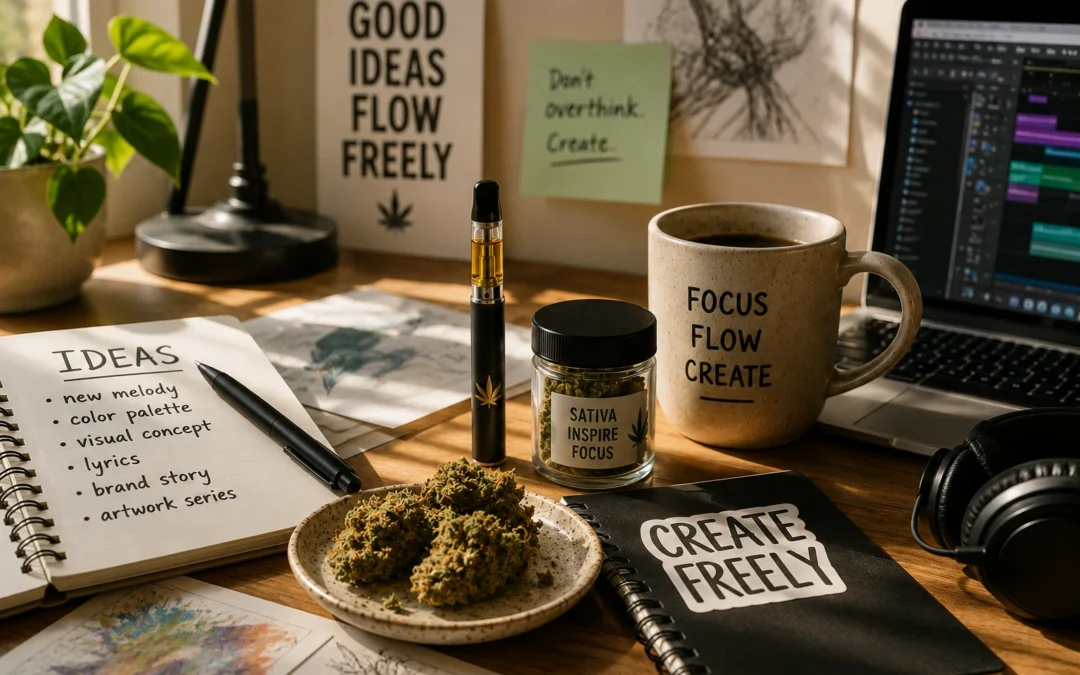
Artists, musicians, writers, and creative professionals have used cannabis for decades. The connection between cannabis and creative work is one of the most talked about aspects of the plant, and one of the most debated.
Some people say cannabis opens up their thinking, loosens mental blocks, and helps them see new connections. Others say it makes them unfocused, scattered, and less productive. Both experiences are real, and the research suggests the relationship between THC and creativity is more nuanced than either side admits.
Here is what the science actually shows, what the anecdotal evidence suggests, and how to approach cannabis as a creative tool if you want to try it.
What “Creativity” Means in Research
Before looking at the research, it helps to define what creativity means in a scientific context. Researchers typically break creativity into two components:
Divergent thinking is the ability to generate multiple ideas, solutions, or associations from a single starting point. Brainstorming, free association, and coming up with unusual connections all fall under divergent thinking. This is the type of thinking most people associate with “being creative.”
Convergent thinking is the ability to narrow down options and find the single best solution to a well-defined problem. Editing, refining, troubleshooting, and making critical decisions are convergent tasks.
Most creative work involves both. A songwriter brainstorms melody ideas (divergent) and then arranges and edits the best one into a finished song (convergent). A designer generates visual concepts (divergent) and then refines the chosen direction into a polished deliverable (convergent).
The distinction matters because cannabis appears to affect these two types of thinking differently.
What the Research Suggests
The research on cannabis and creativity is still limited compared to other areas of cannabis science, but a few patterns have emerged.
Low doses may support divergent thinking. Several studies have found that low to moderate doses of THC can increase divergent thinking, particularly in people who do not score high on creativity baseline tests. The theory is that THC’s effect on dopamine and its ability to reduce inhibition can loosen mental filters, allowing more free-flowing idea generation.
Higher doses tend to impair performance. When THC doses increase, the benefits for divergent thinking appear to diminish or reverse. Higher doses can cause cognitive fog, reduced working memory, and difficulty maintaining a train of thought, all of which work against both divergent and convergent thinking.
Convergent thinking may be impaired at most doses. Tasks that require focused, analytical reasoning tend to suffer under the influence of THC. Editing a document, debugging code, making detailed design decisions, or solving logic problems may feel harder after consuming cannabis.
Cannabis may change how you perceive your own creativity. One consistent finding across studies is that cannabis users tend to rate their own work as more creative while under the influence, even when external judges do not agree. THC can increase the subjective feeling of creativity without necessarily improving the objective output. This is important to be aware of if you are using cannabis during professional creative work.
Set, setting, and individual variation matter enormously. The same dose of the same product can affect two people completely differently. Your baseline creativity, tolerance, mood, environment, and expectations all influence the outcome. Research averages do not capture this individual variation well.
The Creative Consumer’s Experience
Outside of controlled studies, the anecdotal picture is more favorable. Many creative professionals report genuine benefits from incorporating cannabis into their process, with some important caveats.
Cannabis seems to help most with the early, generative phases of creative work. Brainstorming sessions, conceptual development, musical improvisation, free writing, and visual exploration are the activities where cannabis users most commonly report a benefit. The loosened mental state can help you move past perfectionism, self-censorship, and the blank-page paralysis that kills creative momentum.
It seems to help less with refinement and execution. Editing, mixing, color correction, precision layout work, and any task requiring sustained analytical focus are generally harder under the influence. Many creative professionals who use cannabis during ideation switch to a sober state for the detail work.
The sweet spot is usually a low dose. A single draw from a vape pen or a 2.5 mg edible is a common “creative dose” among experienced users. The goal is a subtle shift in perspective, not a full-body high. If you feel noticeably impaired, you have probably taken too much for productive creative work.
Strain type matters. Sativa and sativa-dominant hybrid strains are the traditional choice for creative activities. These strains tend to produce more mentally stimulating, uplifting effects compared to indicas, which lean toward physical relaxation and sedation. Terpene profiles also play a role: limonene and pinene, both associated with alertness and mood elevation, are common in strains favored by creative consumers. For more on how terpenes shape your experience, check out our post on understanding terpenes.
How to Use Cannabis for Creative Work
If you want to experiment with cannabis as a creative tool, here are some practical guidelines based on both research and common practice.
Start With a Clear Intention
Before you consume, define what you are working on and what phase of the project you are in. If you are brainstorming, free writing, or sketching initial concepts, cannabis may help. If you are editing, proofreading, or doing technical execution, it probably will not.
Having a creative task ready before you consume keeps the session productive. Cannabis without direction tends to lead to passive consumption (watching videos, scrolling your phone) rather than active creation.
Use a Low Dose
For creative work, less is almost always more. One or two draws from a vape pen or a 2.5 mg edible is enough to shift your thinking without impairing your ability to execute.
Microdosing (doses below 5 mg for edibles or a single, small inhale for vapes and flower) has become popular among creative professionals for exactly this reason. The effect is subtle: a slight mood lift, a loosening of mental rigidity, and a heightened sensitivity to sensory input without the fog of a full dose.
Choose the Right Product
Vape pens and cartridges are ideal for creative sessions because the onset is immediate and the dose is easy to control. You can take a single draw, assess how you feel, and decide whether to continue.
Cannabis flower offers the most complete terpene and cannabinoid experience. If flavor and the full-spectrum entourage effect matter to you, flower through a dry herb vaporizer at low temperature preserves terpenes better than combustion.
Edibles work for longer creative sessions but require more planning. Take your edible 60 to 90 minutes before you want to start working, and stick to a low dose. The extended duration (4 to 8 hours) means you need to be comfortable with the effects lasting through your session.
Keep Your Tools Ready
Have your creative tools set up before you consume. If you are writing, have your document open. If you are making music, have your DAW loaded. If you are drawing, have your supplies or tablet out.
Cannabis motivation tends to flow toward whatever is in front of you. If your workspace is ready, you will create. If your couch and TV are ready, you will watch.
Record Everything
One of the genuine benefits of cannabis for creativity is the unexpected connections and ideas it can generate. The problem is that these ideas are harder to retain under the influence of THC, which affects short-term memory.
Record your ideas as they come. Voice memos, quick notes, rough sketches, or screen recordings capture the raw output. You can review and refine them later when you are sober and can evaluate with fresh eyes.
Review Your Work Sober
This is the most important step. Cannabis can make you feel like everything you create is brilliant. Sometimes it is. Sometimes it is not.
Always review your cannabis-session output the next day with a clear head. The ideas that hold up are keepers. The ones that do not were still worth generating because they might lead to something better in the next round.
Cannabis Is a Tool, Not a Shortcut
Cannabis does not make you creative. It can remove certain mental barriers, shift your perspective, and help you access a looser, more playful state of mind. But the creative skill, the taste, the technical ability, those come from you.
The most productive approach is to treat cannabis as one tool in your creative toolkit. Use it selectively, at low doses, during the phases of work where it genuinely helps. Pair it with sober review sessions where you refine the raw material into polished output.
Ready to explore strains that fit your creative process? Browse the Caña menu and order online for delivery across the San Fernando Valley, Burbank, Northridge, Hollywood, and West Hollywood. Need help finding the right product? Get in touch with the team and we will help you pick something that matches your workflow.